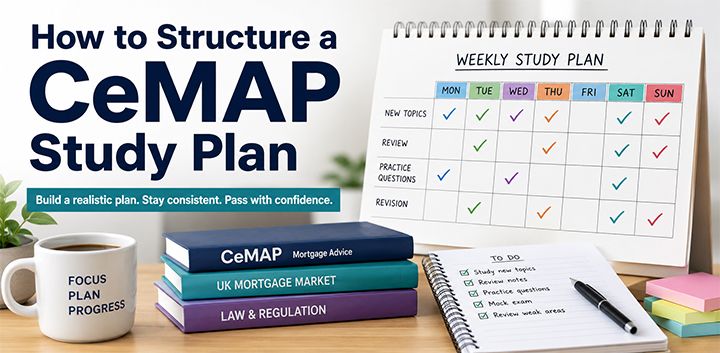
A structured CeMAP study plan gives you a clear way to work through the qualification without trying to study everything at once. It should divide your learning into manageable sections, include regular revision and practice questions, and leave enough flexibility to spend longer on topics you find difficult.
There is no single CeMAP study timetable that will suit everyone. Some learners can study several times during the working week, while others may have to fit their learning around a full-time job, family commitments or other responsibilities.
The important part is not following a rigid timetable. It is knowing what you are studying, when you are going to study it and how you will check that you have understood it.
A good CeMAP study plan normally combines four things:
- Learning new topics
- Reviewing previous topics
- Completing practice questions
- Revisiting weaker areas
Getting that balance right can make CeMAP study feel much more manageable.
How Should I Structure My CeMAP Study?
You should structure CeMAP study by breaking the qualification into smaller learning goals rather than simply planning a certain number of study hours.
For example, “study CeMAP for two hours” tells you when you are studying but not what you intend to achieve. A clearer goal might be to complete a particular section of your course, review your notes and then answer practice questions relating to that material.
This gives each study session a purpose.
A simple structure could be:
Learn → Review → Practise → Check → Revisit
You first work through the learning material, review the important points, test yourself with questions and identify anything that needs further attention.
This process can then be repeated as you progress through the course.
How Should I Structure My CeMAP Study?
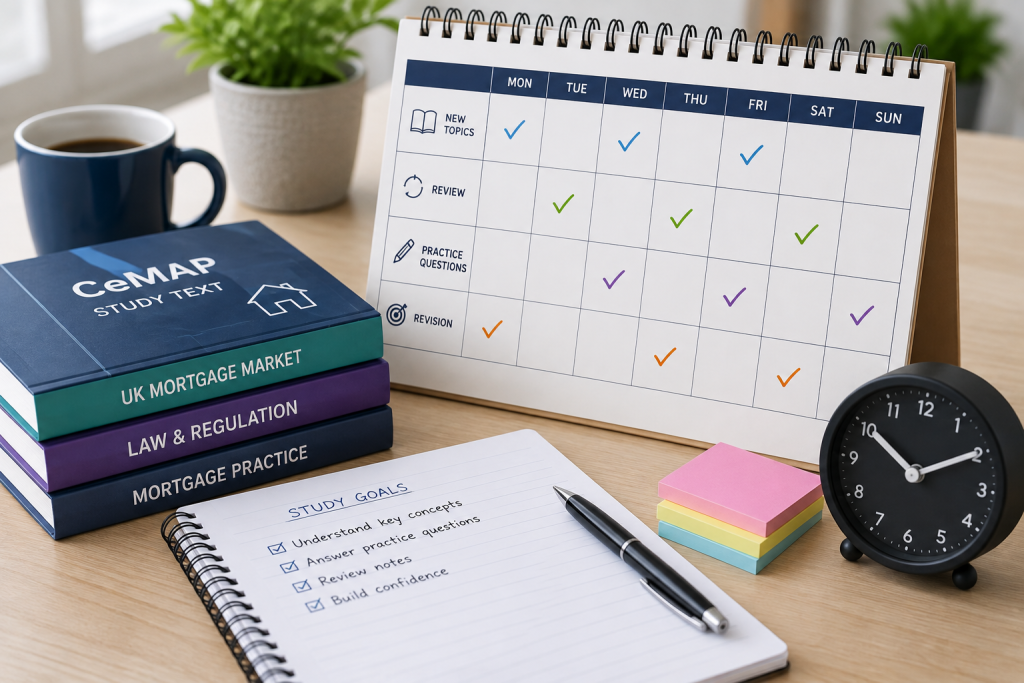
A weekly CeMAP study plan should normally include both new learning and revision rather than concentrating entirely on one or the other.
When you first begin a module, most of your time will naturally be spent learning new material. As you progress, revision and question practice should gradually become a larger part of your study.
For example, a learner studying three times during the week might use:
Session 1: New learning
Work through the next planned section of the course and make or review study notes.
Session 2: New learning and review
Continue with the course, followed by a short review of material covered previously.
Session 3: Practice and consolidation
Complete relevant practice questions and revisit areas where your understanding is weaker.
This does not mean every week has to follow exactly the same pattern.
If you encounter a difficult topic, it may make sense to spend an additional session on it. If you are progressing comfortably, you may be able to move forward more quickly.
The timetable should support your learning rather than control it.
How Much CeMAP Study Should You Plan Each Week?
The right amount of CeMAP study depends on your available time, existing knowledge and how quickly you understand the material.
A learner with previous financial services experience may recognise some concepts immediately. Someone completely new to mortgages and financial services may need more time to understand terminology and how different areas fit together.
Instead of asking only, “How many hours should I study?”, it can be more useful to ask:
What can I realistically complete each week without rushing?
Consistency is often more useful than occasional long study sessions.
Three manageable sessions spread across a week, for example, may be more effective for some learners than trying to complete all their study in one long session at the weekend.
Your plan also needs to be realistic about your normal life. A timetable that only works during a quiet week is unlikely to remain useful when work becomes busy or other commitments appear.
How Should You Balance New CeMAP Topics With Revision?
CeMAP revision should begin while you are still learning rather than being left entirely until you have finished the course material.
This is particularly important because earlier knowledge can support your understanding of later areas.
A simple approach is to build short reviews into your normal study sessions.
Before beginning new material, spend 10 or 15 minutes reviewing something you studied previously. This might involve reading your study notes, using study cards or answering a small number of questions.
You can then move on to the new material.
Over time, this creates repeated contact with important information rather than relying on one large revision period immediately before the exam.
Do You Need to Revise Everything Every Week?
No. Trying to review everything you have studied every week would quickly become impractical.
Instead, rotate your revision.
You might review one earlier topic during one session and another topic later in the week. Areas you find difficult can appear more frequently in your revision schedule.
This allows revision to remain manageable as the amount of material you have covered increases.
When Should Practice Questions Be Added to Your CeMAP Study Plan?
Practice questions should be used throughout CeMAP study, not only when you have finished learning all the material.
Once you have studied a topic, answering relevant questions can help you check whether you have actually understood it.
This is different from simply rereading your notes.
You may feel familiar with a subject when reading about it, but a question requires you to recognise what is being asked, recall the relevant knowledge and choose the correct answer.
When you get a question wrong, avoid simply checking the answer and moving on. Try to identify why you got it wrong.
Was it because you:
- Did not know the information?
- Misunderstood the topic?
- Misread the question?
- Confused two similar concepts?
- Changed a correct answer unnecessarily?
That information can help determine what should go into your next study session.
As you get closer to an exam, your plan can gradually shift towards more question practice, revision and mock exams.
What Does a CeMAP Study Schedule Look Like in Practice?
There are several ways to organise CeMAP study depending on the time you have available.
Example 1: Studying Around a Full-Time Job
A learner might choose three sessions:
Tuesday evening, 60–90 minutes
Learn a new section of the course.
Thursday evening, 60–90 minutes
Review Tuesday’s material and continue with new learning.
Sunday, 90–120 minutes
Complete practice questions, review notes and revisit weaker areas.
The exact days are not important. The structure is what matters.
Example 2: Shorter, More Frequent Study
Some learners prefer shorter sessions:
Monday: 30–45 minutes of new learning
Tuesday: 30 minutes continuing the topic
Thursday: 30–45 minutes of new learning
Friday: 20–30 minutes of revision
Sunday: 45–60 minutes of questions and review
This can work well if concentrating for long periods is difficult or if your schedule makes longer sessions impractical.
Example 3: Mainly Weekend Study
If weekdays are difficult:
Saturday morning: Main learning session
Saturday afternoon or evening: Short review
Sunday: Continue learning and complete practice questions
You could then use one or two short periods during the week for study cards, notes or quick revision.
These are examples rather than prescribed CeMAP study timetables. The best schedule is one you can realistically maintain.
How Do You Know When to Move on to the Next CeMAP Topic?
You do not need to know every detail perfectly before moving forward, but you should have a reasonable understanding of the main concepts.
Waiting until you feel you have completely mastered every section can make progress unnecessarily slow.
Equally, rushing through topics simply to say they are completed can create gaps that become more noticeable when you start practice questions.
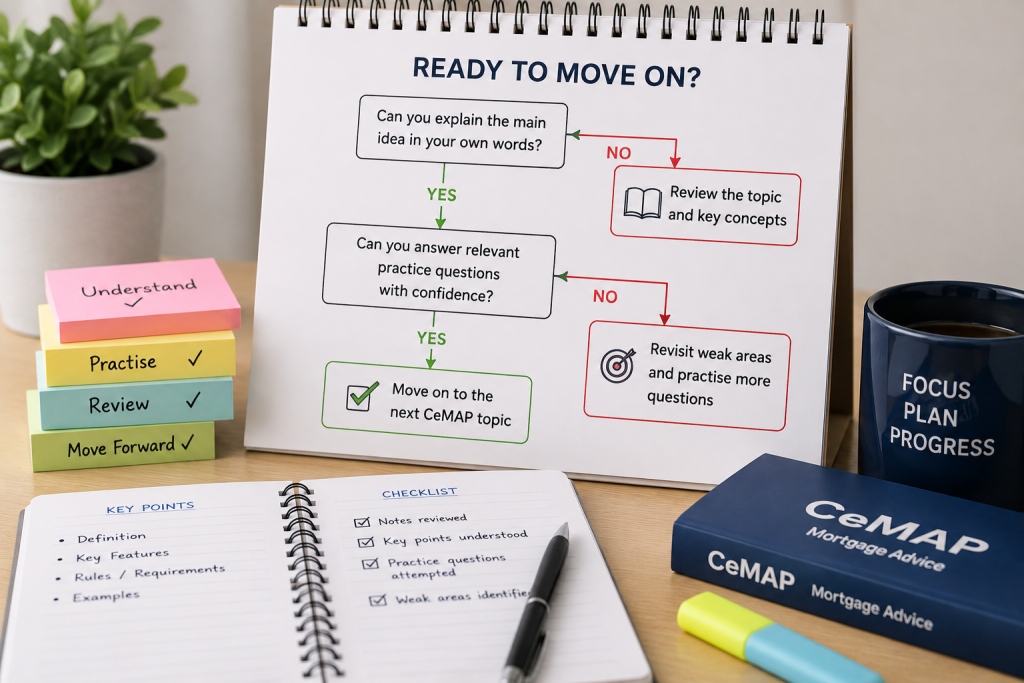
A useful checkpoint is whether you can explain the main idea in your own words and answer relevant practice questions with a reasonable level of confidence.
If not, spend some additional time reviewing the material.
If one particular detail is causing difficulty, make a note of it and include it in future revision rather than allowing one point to stop all progress.
How Should Your Study Plan Change Before a CeMAP Exam?
As you approach a CeMAP exam, your study plan should gradually move away from mainly learning new material and towards consolidation.
This is the stage where you should be bringing together what you have learned.
Your sessions may include:
- Reviewing course summaries and study notes
- Revisiting weaker topics
- Completing larger sets of practice questions
- Working through mock exams
- Reviewing incorrect answers
- Checking areas where similar concepts are easily confused
Mock exams are particularly useful at this stage because they allow you to test your knowledge across a broader range of material.
The results should also guide your remaining revision.
If a mock identifies a weak area, your timetable can be adjusted so that the topic receives more attention before you attempt another mock.
What Are the Most Common CeMAP Study Planning Mistakes?
One common mistake is creating a study timetable that is too ambitious.
Planning to study every evening may look organised on paper, but it is not useful if you know you are unlikely to maintain it.
Another mistake is measuring progress only by time.
Spending three hours with your course open does not necessarily mean three productive hours of learning. Having a clear objective for each session gives you a better measure of progress.
Other common problems include:
- Leaving all practice questions until the end
- Never returning to earlier topics
- Spending too much time repeatedly studying areas you already know
- Ignoring weaker subjects because they feel difficult
- Trying to make up missed sessions by cramming
- Moving through the course purely to meet an arbitrary deadline
Your study plan should be adjustable. Missing a session does not mean the whole timetable has failed. Move the work to another realistic point and continue.
Should You Plan CeMAP Study Around an Exam Date?
An exam date can provide a useful target, but it should not encourage you to rush your learning.
If you already have an exam booked, work backwards from the date and make sure you leave sufficient time for revision and mock exams rather than planning new learning right up to the final day.
If you have not booked your exam yet, you can instead use progress milestones.
For example:
Stage 1: Work through the learning material
Stage 2: Consolidate each topic
Stage 3: Increase question practice
Stage 4: Complete mock exams and targeted revision
Stage 5: Prepare for the exam
This provides structure without forcing your studies into an unrealistic deadline.
What Is the Best CeMAP Study Plan?
The best CeMAP study plan is one that gives you consistent progress while remaining flexible enough to fit your circumstances.
You do not need a complicated spreadsheet or a timetable planned months in advance.
Start with the time you genuinely have available. Decide what you want to achieve during each session. Combine new learning with regular revision and question practice. Then adjust the plan according to your progress.
A structured approach does not mean every learner studies CeMAP in exactly the same way.
It means you always know what you are working on, what you have already covered and what needs your attention next.
That simple structure can turn CeMAP from one large qualification to tackle into a series of much more manageable learning goals.
Looking for training support?
We offer CeMAP training for learners working towards a career in mortgage advice. Our courses follow the London Institute of Banking & Finance syllabus and are designed to support understanding of mortgage regulation and advice requirements.
Explore our accredited CeMAP training courses
> Futuretrend Financial Training