How CeMAP exams work from registration to results

CeMAP exam process illustration showing online registration, remote invigilation and exam results on screen

If you are preparing to sit a CeMAP exam for the first time, it is completely normal to feel unsure about the process. Many learners are confident with the content but uncertain about what actually happens on the day.

This guide explains exactly how CeMAP exams work, from booking your exam through to receiving your result. It reflects the current exam delivery model used by the London Institute of Banking & Finance (LIBF) and focuses only on CeMAP.

CeMAP exams are:

  • Delivered online through Brightspace
  • Remotely invigilated using Integrity Advocate
  • Taken on demand
  • Multiple-choice assessments

They are regulated professional exams, and the rules are strict. Understanding the process in advance helps remove unnecessary stress.

CeMAP exam process illustration showing online registration, remote invigilation and exam results on screen

How do you register and access a CeMAP exam?

CeMAP exams are booked on demand. There are no fixed national exam dates.

Booking your exam

Each CeMAP unit is booked separately. Once you have:

  • Registered for the unit
  • Paid the exam fee

your exam attempt becomes available within your Brightspace account.

You will see:

  • A content course site (where your learning materials are)
  • An associated exam course site

Within the content site, there is a section titled “Sit your examination here”. This link only appears if you have an unused exam attempt remaining.

You should not enter the exam area until you are ready to sit the exam. Once you proceed into the remote invigilation checks, you are entering exam conditions.

CeMAP exams are on demand, meaning you can start your exam when you are ready, rather than at a fixed national time.

Can I sit exams from home?

Yes. CeMAP exams are designed to be taken from home or another suitable private location, using remote invigilation.

Remote invigilation means your exam is monitored live and recorded using your device’s camera, microphone, and screen sharing software.

However, strict conditions apply.

What are the room and equipment requirements?

Before your exam begins, you must meet the testing space and system requirements set by LIBF.

Your testing space must be:

  • Enclosed
  • Private
  • Quiet
  • Well lit
  • Free from interruptions


Your desk must be completely clear. The only items permitted are:

  • Your computer or laptop
  • A beverage in a transparent, unlabelled container


You are not allowed:

  • Books or notes
  • Paper
  • Pens or pencils
  • Physical calculators
  • Mobile phones
  • Watches or smart watches
  • Headphones or headsets
  • Other electronic devices


Toilet breaks are not permitted during the exam.


You will be required to complete a full 360-degree room scan at the start of the exam. This includes showing:

  • The entire room
  • Above and below your desk
  • Your immediate surroundings


Your camera must remain in position for the entire exam.


If you leave the webcam view, lean off screen, stop screen sharing, or open additional tabs or applications, your exam may be revoked.

CeMAP remote exam room requirements showing clear desk, laptop with webcam, and prohibited items such as phones, books and paper

What technical checks must I complete?

Your device must meet minimum system requirements.

You must:

  • Use a computer or laptop (not a tablet or mobile phone)
  • Have a working webcam and microphone
  • Have a stable internet connection
  • Close all other applications and browser tabs

Your screen will be shared for the entire duration of the exam.

LIBF strongly recommends running the Integrity Advocate demo in advance using the same device and internet connection you plan to use on the day. This helps confirm your system works properly before your live sitting.

Support is available before the exam if you encounter system issues during checks.

What identification do I need?

You must present valid, original, government-issued photo identification.

Accepted forms include:

  • International passport
  • Full or provisional driving licence
  • National identity card
  • Visa or permanent residence card
  • UK Citizen Card (for UK candidates only)

Your ID must:

  • Be in date
  • Be an original document (not digital)
  • Match the first and last name used to register

You will be asked to show your ID clearly to the camera during the check-in process.

What happens when the CeMAP exam starts?

Once your identity and room checks are complete, you will enter the exam introduction screen.

You are under exam conditions from this point onwards.

CeMAP exam format

CeMAP exams are multiple-choice assessments.

Some units include standard multiple-choice questions. Others include case study-based multiple-choice questions. If you want a detailed breakdown of question structures, refer to the individual CeMAP 1, CeMAP 2 and CeMAP 3 guides.

During the exam:

  • Questions appear on screen
  • A navigation panel allows you to move between questions
  • A timer shows the remaining time
  • A progress indicator shows how many questions are left

If your time runs out, the exam will automatically submit.

You will have access to:

  • An on-screen scientific calculator
  • An on-screen notepad for rough work
  • A flag function to mark questions you want to return to
  • Accessibility tools if needed

You cannot use any physical calculator, paper, or external materials.

CeMAP exam start process showing identity checks, room scan and online multiple choice exam under remote invigilation

Can I leave the room during a CeMAP exam?

No.

Once your exam begins:

  • You must remain in view of your webcam
  • You cannot leave the room
  • Toilet breaks are not allowed
  • You cannot speak aloud
  • You cannot communicate with anyone

Audio and video are recorded, and your screen is monitored throughout.

If the system detects potential breaches of exam regulations, your session may be flagged for review.

What happens when I finish the exam?

At the end of the exam, you will see a review screen. This allows you to check which questions you have answered before final submission.

Once you confirm submission:

  • Your answers are sent automatically
  • Screen sharing ends


For CeMAP, which is multiple-choice only, your provisional result will normally appear on screen shortly after submission.

How do I receive my official CeMAP result?

Your official result is released through your MyLIBF account.

Results are not given by telephone or email.

If your exam session is flagged for potential regulation breaches, your result may be temporarily withheld while it is reviewed. Reviews typically take up to three working days. If no breach is confirmed, your result will then be released.

What happens if I fail a CeMAP exam?

If you do not achieve a pass, you can book a resit.

Resits are:

  • Booked in the same way as your first attempt
  • Subject to a further exam fee

CeMAP must be completed within the registration period set by LIBF. If you do not complete all required units within that timeframe, you may need to re-register.

What is Special Consideration?

Special Consideration applies if an unforeseen circumstance beyond your control affects your performance.

Examples may include:

  • Sudden illness
  • Injury
  • Significant unexpected events

Important rules apply:

  • You must notify LIBF within 48 hours of the exam date
  • By sitting the exam, you are declaring yourself “fit to sit”
  • Applications require supporting evidence
  • Avoidable circumstances, such as holidays or lack of preparation, are not accepted

If you believe Special Consideration applies, you should contact LIBF customer services promptly and review their policy before booking further exams.

CeMAP Special Consideration process showing 48-hour rule, supporting evidence requirement and examples such as sudden illness or injury

What should I understand before sitting CeMAP?

CeMAP exams are structured, secure, and professionally monitored assessments.

Before sitting your exam, you should clearly understand:

  • It is taken online through Brightspace
  • It is remotely invigilated
  • The room must be completely clear
  • You cannot leave the room
  • You cannot use paper or a physical calculator
  • Screen sharing runs for the entire exam
  • Results appear on screen and on MyLIBF
  • Sitting the exam means you declare yourself fit to sit

Once you understand the process, the experience becomes predictable. The structure is firm, but it is consistent for every candidate.

Knowing exactly what to expect removes uncertainty and allows you to focus on what matters — completing your CeMAP exam properly and professionally.

Looking for training support?

We offer CeMAP training for learners working towards a career in mortgage advice. Our courses follow the London Institute of Banking & Finance syllabus and are designed to support understanding of mortgage regulation and advice requirements.

Explore our accredited CeMAP training courses

> Futuretrend Financial Training 

CeMAP 1, 2 and 3 explained in plain English (2025/26)

CeMAP 1, 2 and 3 explained showing FSRE, MRT1, MRT2 and ASSC modules under the 2025/26 structure

What is CeMAP 1, 2 and 3?

CeMAP is a single Level 3 qualification, not three levels.

It is formally called the Certificate in Mortgage Advice and Practice and is awarded by the London Institute of Banking & Finance (LIBF). LIBF is part of the Walbrook Group, which is why learners may see Walbrook branding when visiting the LIBF website or accessing learning platforms.

Completing CeMAP meets the education requirements set by the Financial Conduct Authority (FCA) for giving mortgage advice in the UK.

When people talk about CeMAP 1, CeMAP 2 and CeMAP 3, they are referring to modules within the same qualification, not stages or levels of qualification.

This distinction matters. A lot of confusion around CeMAP comes from the assumption that:

  • CeMAP 1 is a “lower level”
  • CeMAP 2 is a “higher level”
  • CeMAP 3 is the “final level”

That is not correct.

CeMAP has always been one qualification, made up of multiple modules. The module names and structure have been updated for 2025/26, but the underlying principle is the same.

CeMAP 1, 2 and 3 explained showing FSRE, MRT1, MRT2 and ASSC modules under the 2025/26 structure

Why do the old CeMAP 1, 2 and 3 names still exist?

The older naming still appears mainly because it is familiar shorthand.

For many years, the qualification was commonly described as:

  • CeMAP 1
  • CeMAP 2
  • CeMAP 3


LIBF has since updated the structure and module titles to better reflect what is being studied. However, the older terms still appear in:

  • online discussions
  • older learning materials
  • informal conversations in the industry

This does not mean the qualification has different versions or levels.


The important point for new learners is this:

  • You will study the current modules
  • You will sit the current exams
  • Older labels are informal references, not separate qualifications

A critical clarification: CeMAP modules are not levels

This is the misconception that causes the most confusion.

  • CeMAP 1, 2 and 3 are not levels
  • They do not represent progression through qualification levels
  • They do not grant partial adviser status

All modules combine to form one Level 3 qualification.

Completing one or two modules does not change the level of the qualification. It only means you have partially completed CeMAP.

You are only considered CeMAP qualified once all required modules are completed.

Graphic explaining that CeMAP 1, 2 and 3 are modules, not levels, showing FSRE, MRT1, MRT2 and ASSC within one qualification

What is CeMAP 1 now?

CeMAP 1 refers to the FSRE module

Under the 2025/26 structure, what people call CeMAP 1 is now the Financial Services, Regulation and Ethics (FSRE) module.

FSRE covers the regulatory and ethical foundations of financial advice. It is not mortgage-specific.

In plain terms, FSRE explains:

  • how UK financial services are regulated
  • who the regulators are and what they do
  • the role and responsibilities of advisers
  • ethical behaviour and treating customers fairly
  • how the advice process is meant to work

A note on level classification

Although the overall CeMAP qualification is Level 3, FSRE itself is classified as a Level 4 module and exam under the current structure.

This does not mean FSRE is a higher qualification. It reflects the depth and complexity of regulatory and ethical knowledge being assessed, and the fact that this content underpins multiple financial advice pathways, not just mortgages.

What FSRE does and does not allow

FSRE does not qualify someone to give mortgage advice.

However, because it focuses on regulation and ethics, some employers accept FSRE alone for:

  • administration roles
  • trainee or support positions
  • compliance or case-checking support

This is role-dependent, not adviser status.

How FSRE is assessed

FSRE is assessed by multiple-choice exams set by LIBF. There is no coursework and no practical assessment at this stage.

What is CeMAP 2 now?

CeMAP 2 refers to the mortgage modules: MRT1 and MRT2

What people traditionally call CeMAP 2 is now split into two mortgage-focused modules:

  • MRT1
  • MRT2

Together, these cover the technical knowledge required to advise on mortgages.

What MRT1 covers

MRT1 focuses on how mortgages work in practice, including:

  • mortgage structures and repayment methods
  • interest rates and lender products
  • how lenders assess applications
  • the property purchase and remortgage process
  • the adviser’s role within that process

What MRT2 covers

MRT2 builds on this knowledge and looks at:

  • more complex borrower circumstances
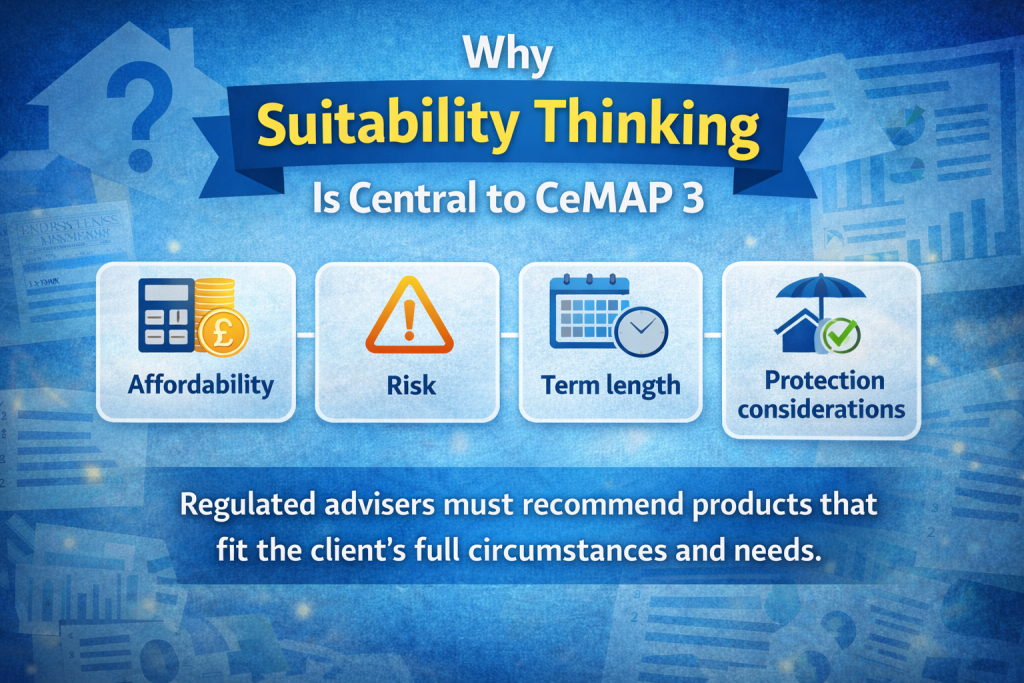
  • affordability and risk considerations
  • suitability and ongoing responsibilities
  • issues that can arise after completion

How MRT1 and MRT2 are assessed

Both MRT1 and MRT2 are assessed by multiple-choice exams set by LIBF.

Passing these modules means you have completed the mortgage knowledge component of CeMAP, but you are still not fully CeMAP qualified at this stage.

What is CeMAP 3 now?

CeMAP 3 refers to the ASSC module

CeMAP 3 is now called Assessment of Suitability Standards in a Customer Scenario (ASSC).

This module assesses whether you can:

  • understand a client’s circumstances
  • identify needs and objectives
  • recommend suitable mortgage solutions
  • apply regulation and ethics correctly

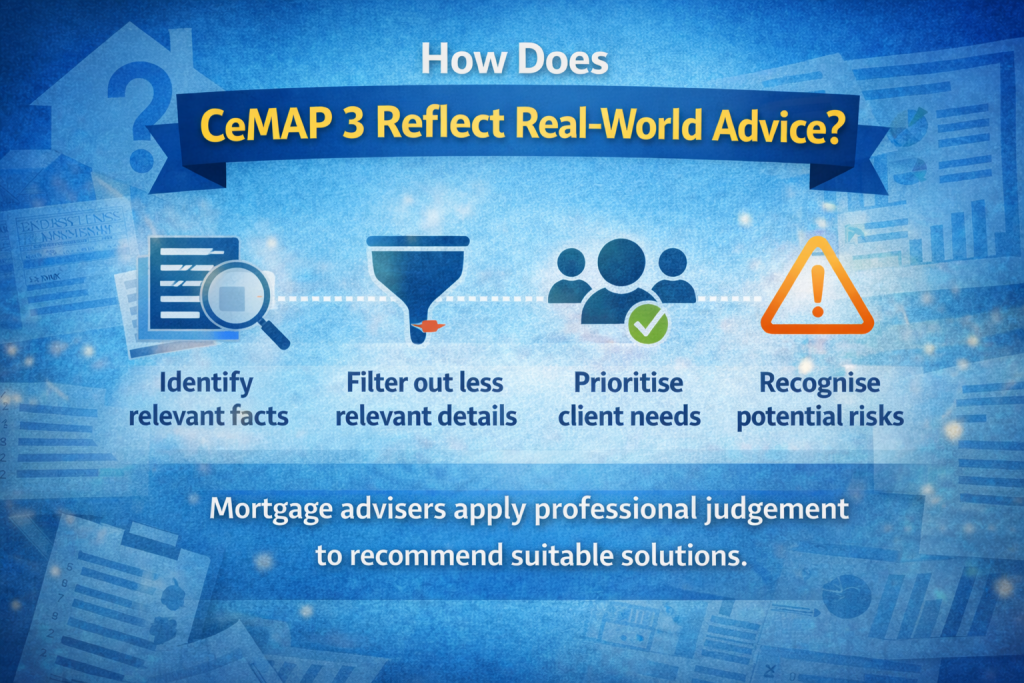
It focuses on application, not memorisation.

How ASSC is assessed

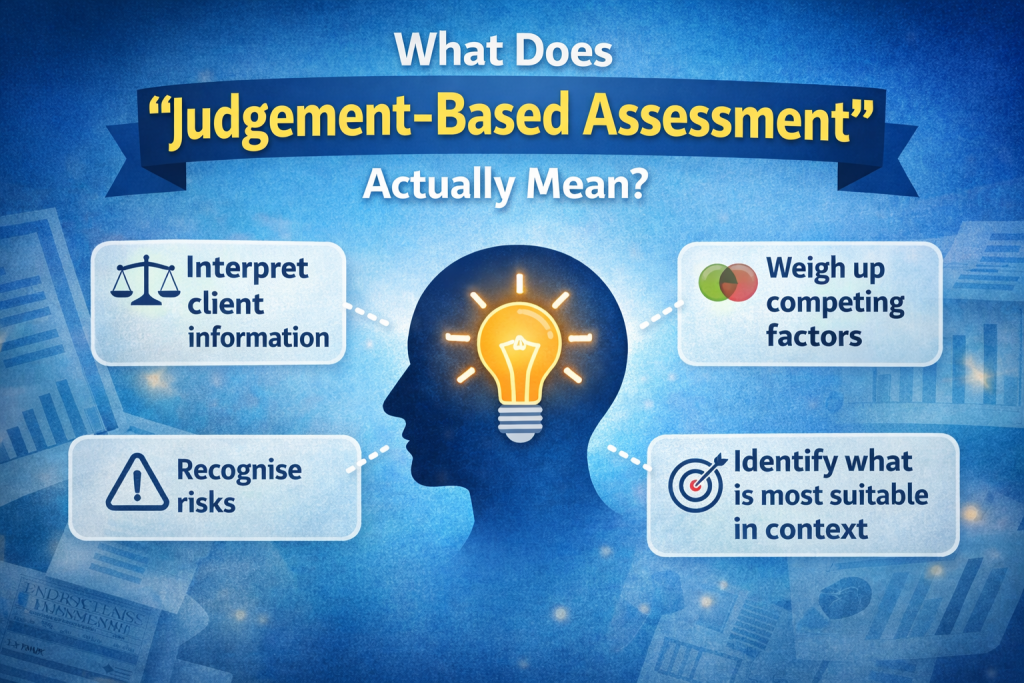
ASSC is assessed through a case-study-based exam using realistic customer scenarios. The assessment tests judgement and suitability rather than technical recall alone.

Is there a required order to study the modules?

There is no mandatory study order set by LIBF for FSRE, MRT1 and MRT2.


LIBF acknowledges that learners may study in different patterns, for example:

  • FRE1, then MRT1
  • returning to FRE2
  • then completing MRT2


That said, many learners find it easier to study module by module, rather than switching between regulation and mortgage content.


A common and structured approach is:

  1. Complete FSRE (FRE1 & FRE2) first
  2. Move on to MRT1 and MRT2 in order
  3. Finish with ASSC


This keeps learning styles consistent and helps learners stay focused, rather than constantly switching between regulatory and technical thinking.


The only strong recommendation is that ASSC is taken last, as it is based on knowledge from the other modules.

How all CeMAP modules fit together

CeMAP is designed to build:

  • foundations (FSRE)
  • technical knowledge (MRT1 and MRT2)
  • real-world application (ASSC)

All modules together form one qualification.

None of them represent separate qualification levels on their own.

Icons representing the three CeMAP modules: FSRE, MRT1 and MRT2, and ASSC within one qualification

Conclusion

  • CeMAP is one Level 3 qualification


  • CeMAP 1, 2 and 3 are module labels, not levels


  • FSRE is a Level 4 module within a Level 3 qualification


  • MRT and ASSC complete the qualification


  • You are only CeMAP qualified once all modules are completed

This clarity removes most of the confusion learners face when starting CeMAP.

Looking for training support?

We offer CeMAP training for learners working towards a career in mortgage advice. Our courses follow the London Institute of Banking & Finance syllabus and are designed to support understanding of mortgage regulation and advice requirements.

Explore our accredited CeMAP training courses

> Futuretrend Financial Training 

How the CeMAP qualification is structured (modules, exams and outcomes)

Diagram showing the CeMAP qualification structure with CeMAP 1, CeMAP 2 and CeMAP 3, including units, exams and time limits.

The Certificate in Mortgage Advice and Practice (CeMAP) is the standard qualification required to meet the education requirements for mortgage advisers in the UK. It is awarded by the London Institute of Banking & Finance (LIBF) and is recognised by the Financial Conduct Authority (FCA) for mortgage advice purposes.

Under the 2025/26 syllabus, CeMAP is made up of five mandatory units, assessed through five separate exams, grouped into three stages commonly referred to as CeMAP 1, CeMAP 2 and CeMAP 3.

All units must be passed to achieve the full CeMAP qualification.

Diagram showing the CeMAP qualification structure with CeMAP 1, CeMAP 2 and CeMAP 3, including units, exams and time limits.

What is the structure of the CeMAP qualification?

CeMAP is a unit-based qualification. Each unit:

  • Has a defined syllabus and learning outcomes
  • Is assessed by a formal exam
  • Can be taken individually
  • Contributes to the full CeMAP award


The qualification structure is:

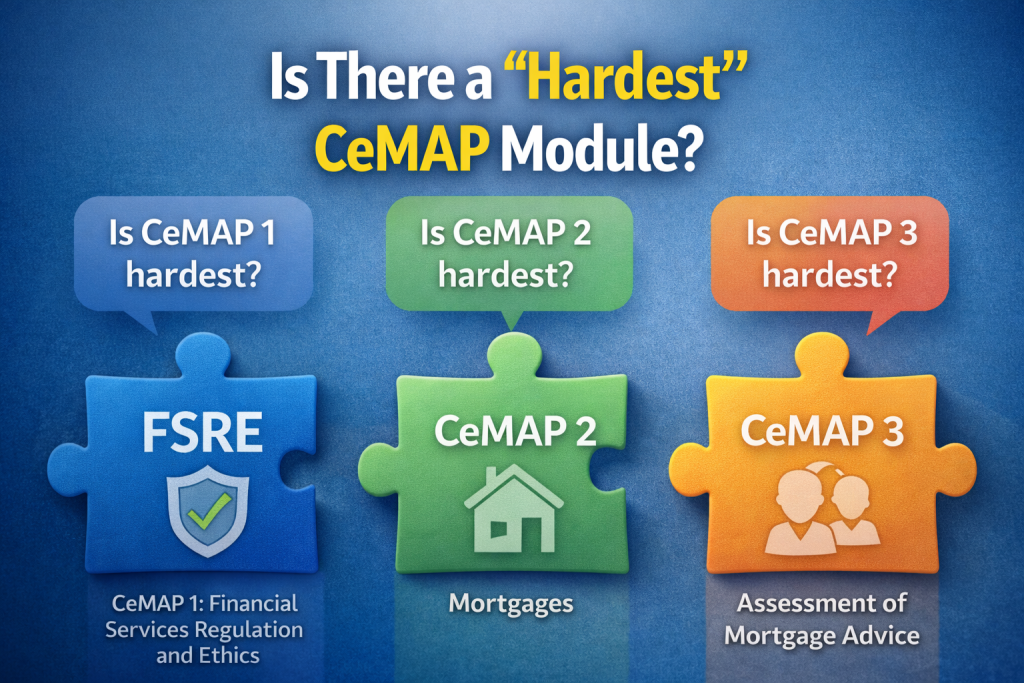
  • CeMAP 1 – Financial services, regulation and ethics
  • CeMAP 2 – Mortgages
  • CeMAP 3 – Assessment of mortgage advice knowledge

CeMAP structure at a glance

CeMAP 1: Financial Services, Regulations and Ethics

  • FRE1 – Regulation, legislation and key parties
  • FRE2 – Skills, principles and ethical behaviours


CeMAP 2: Mortgages

  • MRT1 – Mortgage law, practice and application
  • MRT2 – Mortgage products and post completion


CeMAP 3

  • ASEW – Assessment of Mortgage Advice Knowledge
Infographic showing the CeMAP structure at a glance, with CeMAP 1, CeMAP 2 and CeMAP 3 and their units.

What does FRE1 cover in CeMAP 1?

FRE1 – Regulation, legislation and key parties


FRE1 introduces the structure and purpose of the UK financial services industry.

This unit covers:

  • How the UK financial services market operates
  • The role of government, the economy, and state benefits
  • Key legal principles that underpin financial advice
  • The development of financial regulation in the UK
  • The responsibilities of the FCA and the Prudential Regulation Authority (PRA)


FRE1 provides the regulatory foundation needed to understand why financial services, including mortgage advice, are regulated.

What does FRE2 cover in CeMAP 1?

FRE2 – Skills, principles and ethical behaviours


FRE2 focuses on how advisers operate, rather than on products or markets.

This unit covers:

  • The financial advice process
  • Adviser responsibilities to consumers
  • Consumer rights and protections
  • Professional standards and ethical behaviour
  • Regulatory expectations around conduct and competence


FRE2 is about behaviour, professionalism, and suitability, not mortgages. It applies across financial services and builds on the regulatory knowledge introduced in FRE1

What does MRT1 cover in CeMAP 2?

MRT1 – Mortgage law, practice and application


MRT1 introduces the regulatory and legal framework that governs mortgage advice and lending in the UK.

This unit covers:

  • Mortgage-specific regulation
  • Key mortgage legislation
  • Roles of lenders, borrowers, and intermediaries
  • Types of mortgage products
  • Mortgage application processes


MRT1 establishes how the UK mortgage market operates within legal and regulatory boundaries.

What does MRT2 cover in CeMAP 2?

MRT2 – Mortgage products and post completion


MRT2 builds on MRT1 and follows the mortgage journey beyond initial application.

This unit covers:

  • Mortgage arrangements and completion
  • Repayment methods and interest structures
  • Arrears, payment difficulties, and lender actions
  • Second charges and bridging finance
  • Mortgage redemption and post-completion issues


MRT2 focuses on applying mortgage knowledge to practical, real-world situations.

What does ASEW cover in CeMAP 3?

ASEW – Assessment of Mortgage Advice Knowledge

CeMAP 3 assesses a learner’s ability to apply mortgage advice knowledge in practice.

This unit focuses on:

  • Analysing client circumstances
  • Assessing suitable mortgage solutions
  • Applying ethical and regulatory judgement
  • Demonstrating appropriate adviser decision-making


ASEW is designed to test application and suitability, rather than technical recall.

How are CeMAP exams structured?

Each CeMAP unit is assessed by one formal exam set by LIBF.

At a high level:

  • One exam per unit
  • Exams are taken individually
  • Units can be passed in any order
  • Results are issued per unit

Exam formats vary by unit but are designed to assess knowledge, understanding, and application appropriate to that stage of CeMAP.

Infographic explaining how CeMAP exams are structured, showing one exam per unit and separate results for each unit.

How do CeMAP registration periods and time limits work?

CeMAP operates under defined registration periods.

Key points learners need to understand:

  • Learners must be registered before sitting exams
  • Registration is time-limited
  • All required exams must be passed within the registration window
  • Registration periods are set and administered by LIBF

If a registration period expires before all units are passed, outstanding units must be re-registered.

What learning order options are available?

LIBF allows flexibility in how CeMAP units are studied and taken.

Learners may:

  • Complete CeMAP 1 before CeMAP 2
  • Spread units over time
  • Sit exams in different sequences

All approaches are acceptable provided registration rules are met.

What is the preferred learner-focused order?

A commonly used learner-focused order is:

FRE1 → FRE2 → MRT1 → MRT2 → ASEW

This progression moves logically from regulation and ethics, into mortgage knowledge, then application and assessment.

What is the outcome of completing CeMAP?

To achieve the full CeMAP qualification:

  • All five units must be passed
  • All exams must be completed within time limits
  • Results are awarded by LIBF

CeMAP confirms that the learner has met the FCA-recognised education requirements for mortgage advice. It does not provide authorisation to give advice, which is a separate regulatory process.

Looking for training support?

We offer CeMAP training for learners working towards a career in mortgage advice. Our courses follow the London Institute of Banking & Finance syllabus and are designed to support understanding of mortgage regulation and advice requirements.

Explore our accredited CeMAP training courses

> Futuretrend Financial Training 

What is CeMAP and why it is required to give mortgage advice

CeMAP mortgage qualification concept showing a house model, certificate, calculator and keys

If you are thinking about becoming a mortgage adviser in the UK, you will quickly come across the term CeMAP. It is not optional, and it is not a company preference. CeMAP exists because mortgage advice is regulated, and advisers must meet a recognised education standard before they can give advice to the public.

This article explains, in simple terms, what CeMAP is, why it exists, who needs it, and what it does and does not allow you to do.

The content follows established UK CeMAP education and quality standards to ensure accuracy and clarity for learners.

CeMAP mortgage qualification concept showing a house model, certificate, calculator and keys

What is CeMAP?

CeMAP is the industry-standard qualification for mortgage advisers in the UK.

CeMAP stands for Certificate in Mortgage Advice and Practice. It is awarded by the London Institute of Banking & Finance (LIBF) and is designed to meet the Financial Conduct Authority’s education requirements for mortgage advice.

In simple terms, CeMAP proves that someone understands how mortgages work, how mortgage regulation operates, and how to give suitable advice to clients.

CeMAP is made up of three units that cover:

  • The UK financial services environment and regulation
  • Mortgage law, products, and repayment methods
  • Assessing clients and providing appropriate mortgage advice

A clear definition of CeMAP

CeMAP is a UK mortgage qualification awarded by the London Institute of Banking & Finance that meets the FCA’s educational requirements for giving regulated mortgage advice.

This definition is important because CeMAP is about education. It does not authorise someone to trade, and it does not make them regulated on its own.

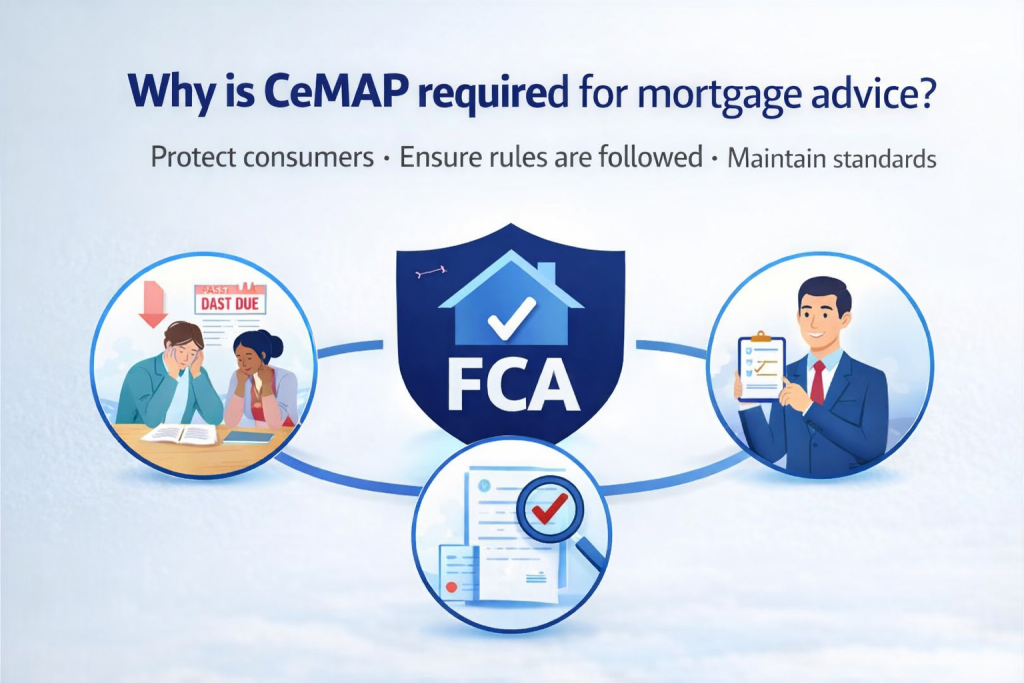
Why is CeMAP required for mortgage advice?

Mortgage advice is regulated because it involves large financial commitments and long-term risk for consumers.

Most people borrow significant amounts of money when taking out a mortgage. Poor advice can lead to financial hardship, repossession, or unsuitable long-term commitments. For this reason, mortgage advice in the UK is regulated by the Financial Conduct Authority (FCA).

The FCA does not allow individuals to give mortgage advice unless they meet specific standards. One of those standards is holding an appropriate qualification. CeMAP is the most widely recognised qualification that meets this requirement.

Illustration showing FCA regulation and why CeMAP is required for mortgage advice

The role of regulation

Regulation exists to:

  • Protect consumers from poor or misleading advice
  • Ensure advisers understand the rules they must follow
  • Create consistent professional standards across the industry

CeMAP supports this by ensuring advisers have a baseline level of technical knowledge and regulatory understanding before they advise clients.

Do you need CeMAP to be a mortgage adviser?

Yes, you need CeMAP, or an equivalent qualification, to give mortgage advice in the UK.

If your role involves recommending mortgage products to clients, you must hold a qualification that meets FCA education standards. CeMAP is the most common qualification used for this purpose.

Without CeMAP (or an accepted equivalent), you cannot legally give regulated mortgage advice, even if you work for an authorised firm.

This applies whether you are:

  • Employed by a mortgage brokerage
  • Self-employed
  • Working under supervision

Training alone is not enough. The qualification itself is required.

Who must hold CeMAP and who does not?

Not everyone working in a mortgage business needs CeMAP. The requirement depends on what you actually do.

Roles that must hold CeMAP

You will need CeMAP if you:

  • Give mortgage advice to clients
  • Recommend specific mortgage products
  • Assess client suitability and affordability as part of advice

These roles are classed as regulated mortgage advice activities.

Roles that do not require CeMAP

You may not need CeMAP if you:

  • Carry out purely administrative work
  • Collect information without giving advice
  • Work in marketing or customer service
  • Act as an introducer without recommending products

However, many people in non-advisory roles still choose to study CeMAP because it supports career progression and deeper understanding of the industry.

What does CeMAP qualify you to do?

CeMAP qualifies you, from an education perspective, to give mortgage advice once you are working for an authorised firm.

Specifically, CeMAP:

  • Meets the FCA’s education requirements for mortgage advisers
  • Demonstrates technical and regulatory knowledge
  • Allows a firm to consider you for an adviser role


Once you hold CeMAP and are authorised by a firm, you can:

  • Advise clients on suitable mortgage products
  • Make regulated mortgage recommendations
  • Work towards full competent adviser status under supervision


CeMAP is often described as the starting point for a mortgage advice career, not the end point.

Illustration showing what CeMAP qualifies a mortgage adviser to do under firm supervision

What does CeMAP not allow you to do?

CeMAP does not authorise you to trade or operate independently.

This is a common area of confusion, so it is important to be clear.

CeMAP does not:

  • Make you FCA authorised
  • Allow you to give advice on your own
  • Replace firm authorisation
  • Remove the need for supervision and competence sign-off

Even with CeMAP, you must work for, or be appointed by, a firm that is authorised by the FCA. The firm is responsible for oversight, compliance, and permissions.

CeMAP is an education requirement. FCA authorisation is a business and regulatory requirement. They are related, but they are not the same thing.

How CeMAP fits into the wider qualification structure

CeMAP is structured as three units, commonly referred to as CeMAP 1, CeMAP 2, and CeMAP 3.

Together, these units build from:

  • Understanding regulation and the financial services environment
  • Learning how mortgages work in practice
  • Applying knowledge to real client scenarios

Many learners study CeMAP in stages, often alongside entry-level roles in mortgage firms. After completing CeMAP, advisers usually move on to supervised practice and, later, more advanced qualifications depending on their career path.

Key points to remember

CeMAP is required because mortgage advice is regulated and consumers need protection.


It is:

  • An FCA-recognised education standard
  • Awarded by the London Institute of Banking & Finance
  • Essential for anyone giving mortgage advice


It is not:

  • FCA authorisation
  • Permission to advise independently
  • A guarantee of employment or success


Understanding this distinction early helps avoid confusion and sets realistic expectations for anyone considering a career in mortgage advice.

Looking for training support?

We offer CeMAP training for learners working towards a career in mortgage advice. Our courses follow the London Institute of Banking & Finance syllabus and are designed to support understanding of mortgage regulation and advice requirements.

Explore our accredited CeMAP training courses

> Futuretrend Financial Training 
LIBF Accredited CeMAP: Why It Matters for Your Study Success

Blog-LIBF Accredited Learning

If you’re considering CeMAP training, you’ve likely come across the phrase LIBF accredited. But what does it actually mean – and why should it matter to you?

CeMAP (Certificate in Mortgage Advice and Practice) is awarded by the London Institute of Banking & Finance (LIBF). The LIBF is the official body that oversees the qualification. When a training provider is LIBF-accredited, it means they’ve met certain quality standards set by the awarding body itself.

In this article, we’ll explain what LIBF accreditation involves, how it affects your learning, and why choosing an accredited provider like Futuretrend can improve your chances of success.

Blog-LIBF Accredited Learning

What Is LIBF Accreditation?

What does ‘LIBF-accredited’ mean?

LIBF accreditation is a formal recognition that a training provider meets the standards required to deliver CeMAP study support in line with the qualification’s aims. It shows that the provider offers up-to-date materials, qualified tutors, and appropriate support for learners preparing for CeMAP.

To be accredited, providers must submit their content, learning structure, and tutor qualifications to LIBF for review. It’s not a one-off tick-box – accredited status is monitored and reviewed regularly.

How does a provider get accredited?

Accreditation involves a detailed application process. LIBF looks at:

  • The structure and content of the course
  • Tutor qualifications and experience
  • Support offered to learners
  • Quality assurance processes

Once approved, the provider must maintain these standards to keep their accreditation. Any changes in delivery or tutors must be reported to LIBF.

View our LIBF Accreditation

Why LIBF Accreditation Matters for CeMAP Students

Confidence in your study materials

Accredited providers follow the official CeMAP syllabus. This ensures that your course content matches what you’ll be tested on in the real exams.

This reduces the risk of outdated material or incorrect exam preparation. You can focus on studying with confidence, knowing your materials are up to standard.

Structured, quality learning experience

An LIBF-accredited provider offers a clear and supportive study path. You’ll get:

  • A well-structured study plan
  • Learning outcomes clearly mapped to the exam units
  • Resources designed to help you stay on track

You’re not just handed a set of notes and left to it. Accredited training providers are expected to help you stay focused and supported.

Recognition and trust in the industry

Training with an accredited provider shows that you’ve taken a professional route to gaining your CeMAP. Many employers trust and recognise names like Futuretrend because of our long-term accreditation and proven success.

See our CeMAP course overview

Tutor Tip: 

LIBF accreditation isn’t just a nice extra, it’s your quality check. It shows the provider is up-to-date, approved, and working to the same standards LIBF uses to assess the exams.

How Futuretrend Supports Your LIBF-Accredited CeMAP Journey

25 years of training experience
Futuretrend has been delivering mortgage training since the late 90s. Over the years, we’ve helped thousands of students prepare for CeMAP, from absolute beginners to advisers looking to refresh or resit.

Read our student success stories

Tailored support and resources

Our courses are designed for flexibility. Whether you’re studying alongside work or full time, we offer:

  • Tutor Q&A support
  • Mock exams
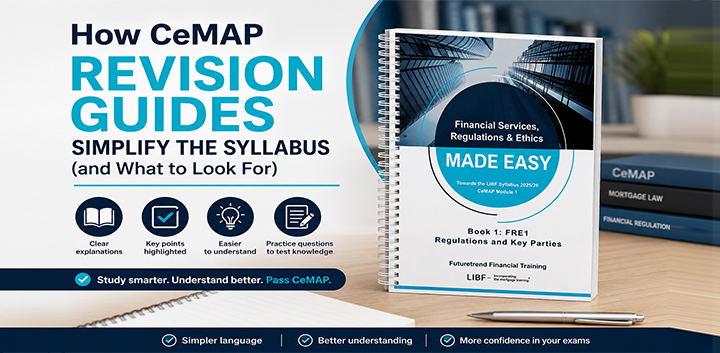
  • Made Easy Revision Guides
  • Regular updates and syllabus changes

We know the CeMAP structure well and build our courses to guide you through every unit.

Flexibility without cutting corners

Online learning doesn’t have to mean second-rate training. With an accredited structure, you get all the benefits of convenience while still working within a recognised framework.

Frequently Asked Questions

What is the difference between LIBF-accredited and non-accredited CeMAP training?

Accredited providers are formally recognised by LIBF and follow strict content and delivery standards. Non-accredited courses may not be updated or structured correctly, and there’s no quality assurance process.

Do I need an accredited provider to sit the CeMAP exam?

No, you can register and take the exam on your own. But working with an accredited provider gives you the structured learning and support that can make a big difference, especially if you’re new to the subject.

How can I check if a provider is accredited by LIBF?

You can check the LIBF website or ask the provider directly. Accredited providers should be happy to show their status and tell you what it means. Futuretrend’s status is detailed here.

Next Steps

If you’re aiming to qualify as a mortgage adviser, your choice of training provider matters. Going with an LIBF-accredited CeMAP provider gives you structure, confidence, and trusted support.

It doesn’t guarantee you’ll pass, but it does mean you’re learning in a way that’s been checked and approved by the awarding body itself.


Ready for more exam-style examples?

Book our CeMAP Home Study course or visit our website for full training resources:

https://cemap123.co.uk/home-study-training/

Explore our accredited CeMAP training courses